Transmon
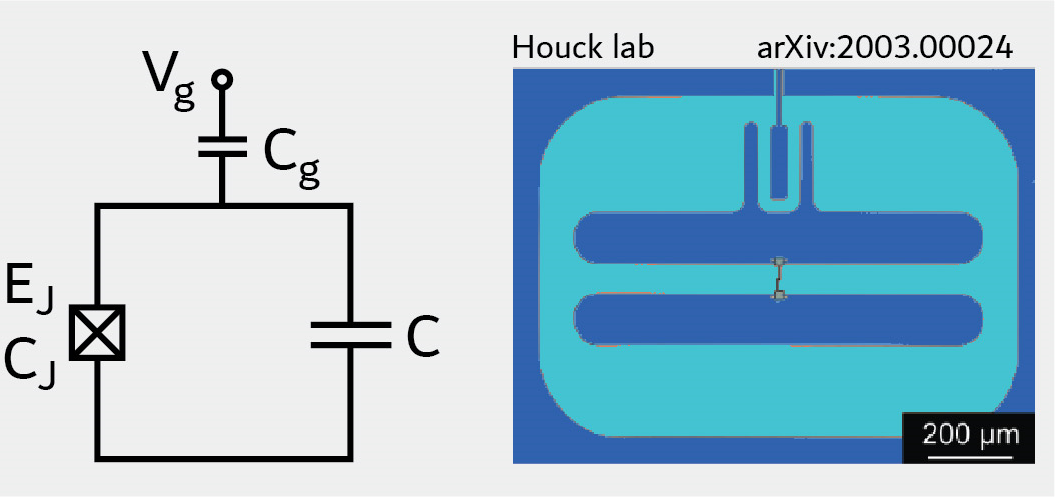
The transmon qubit [Koch2007] is described by the Hamiltonian
expressed in discrete charge basis. Here, \(E_C\) is the charging energy,
\(E_J\) the Josephson energy, and
\(n_g\) the offset charge. Within the Transmon class,
charge-basis representation is employed with a
charge-number cutoff specified by ncut. This cutoff must be chosen sufficiently large for convergence.
An instance of the transmon qubit is initialized as follows:
transmon = scqubits.Transmon(EJ=30.02,
                              EC=1.2,
                              ng=0.3,
                              ncut=31)
From within Jupyter notebook, a transmon instance can alternatively be created with:
transmon = scqubits.Transmon.create()
This functionality is enabled if the ipywidgets package is installed, and displays GUI forms prompting for
the entry of the required parameters.
Wavefunctions and visualization of eigenstates
Return the transmon wave function in number basis. |
|
|
Return the transmon wave function in phase basis. |
Plots transmon wave function in charge basis. |
|
Alias for plot_wavefunction. |
Implemented operators
The following operators are implemented for use in matrix element calculations.
|
Returns charge operator n in the charge or eigenenergy basis. |
Returns operator \(e^{i\varphi}\) in the charge or eigenenergy basis. |
|
|
Returns operator \(\cos \varphi\) in the charge or eigenenergy basis. |
|
Returns operator \(\sin \varphi\) in the charge or eigenenergy basis. |
Computation and visualization of matrix elements
|
Returns table of matrix elements for operator with respect to the eigenstates of the qubit. |
|
Plots matrix elements for operator, given as a string referring to a class method that returns an operator matrix. |
Calculates matrix elements for a varying system parameter, given an array of parameter values. |
|
Generates a simple plot of a set of eigenvalues as a function of one parameter. |
Estimation of coherence times
Show plots of coherence for various channels supported by the qubit as they vary as a function of a changing parameter. |
|
Plot effective \(T_1\) coherence time (rate) as a function of changing parameter. |
|
Plot effective \(T_2\) coherence time (rate) as a function of changing parameter. |
|
|
Calculate the transition time (or rate) using Fermi's Golden Rule due to a noise channel with a spectral density spectral_density and system noise operator noise_op. |
|
\(T_1\) due to dielectric dissipation in the Josephson junction capacitances. |
|
Noise due to charge coupling to an impedance (such as a transmission line). |
Calculate the effective \(T_1\) time (or rate). |
|
Calculate the effective \(T_2\) time (or rate). |
|
|
Calculate the 1/f dephasing time (or rate) due to arbitrary noise source. |
Calculate the 1/f dephasing time (or rate) due to critical current noise. |