Dispersive regime
Coupled systems of qubits and harmonic modes are frequently operated in the dispersive regime where relevant transition frequencies are detuned from each other and hybridization among levels can be treated perturbatively. An effective description of this dispersive regime involves energy corrections and dispersive couplings phrased in terms of
Lamb shifts,
ac Stark shifts, and
Kerr terms,
to leading order. scqubits computes the associated coefficients as part of ParameterSweep and makes them accessible through
"lamb":NamedSlotsNdarraywith axes"subsys", <parameters>, <state label l>"chi":NamedSlotsNdarraywith axes"subsys1", "subsys2", <parameters>, <state label l>"kerr":NamedSlotsNdarraywith axes"subsys1", "subsys2", <parameters>, <state label l, l'>
For instance, here are dispersive ac Stark shifts associated with tmon1 (subsystem 0) and resonator (subsystem 2):
[2]:
sweep["chi"]["subsys1":0, "subsys2":2]
[2]:
NamedSlotsNdarray([[[ 0.00000000e+00, -4.28976197e-04, -7.08859396e-04,
                                 nan],
                    [ 7.10542736e-15, -4.28992818e-04, -7.08785111e-04,
                                 nan],
                    ...,
                    [ 0.00000000e+00, -4.28649766e-04, -7.10242303e-04,
                                 nan],
                    [ 0.00000000e+00, -4.28617406e-04, -7.10371822e-04,
                                 nan]],

                   [[ 0.00000000e+00, -4.30205841e-04, -7.10544871e-04,
                                 nan],
                    [ 7.10542736e-15, -4.30222514e-04, -7.10471590e-04,
                                 nan],
                    ...,
                    [ 0.00000000e+00, -4.29878381e-04, -7.11908181e-04,
                                 nan],
                    [ 0.00000000e+00, -4.29845917e-04, -7.12035771e-04,
                                 nan]],

                   ...,

                   [[ 0.00000000e+00, -4.87527712e-04, -7.59814578e-04,
                                 nan],
                    [ 0.00000000e+00, -4.87546332e-04, -7.60002234e-04,
                                 nan],
                    ...,
                    [ 7.10542736e-15, -4.87160488e-04, -7.56046867e-04,
                                 nan],
                    [-7.10542736e-15, -4.87123928e-04, -7.55665162e-04,
                                 nan]],

                   [[ 0.00000000e+00, -4.86674364e-04, -7.60296164e-04,
                                 nan],
                    [ 0.00000000e+00, -4.86692762e-04, -7.60440317e-04,
                                 nan],
                    ...,
                    [ 7.10542736e-15, -4.86311155e-04, -7.57392697e-04,
                                 nan],
                    [ 0.00000000e+00, -4.86275024e-04, -7.57096569e-04,
                                 nan]]])
Note that the occurence of nan signals that in some instances the breakdown of the dispersive approximation prevents the identification of states with bare product states. Such breakdown regions will result in “interruptions” in plots. While not visually pleasing, they do inform us that the dispersive regime is invalid in those regions and their immediate vicinity.
Simple visualization of the dispersive shift associated with level 1 (ordinarily denoted \(\chi_{01}\)):
[3]:
sweep["chi"]["subsys1":0, "subsys2":2]["ng":0][:, 1].plot()
[3]:
(<Figure size 640x480 with 1 Axes>, <Axes: xlabel='flux'>)
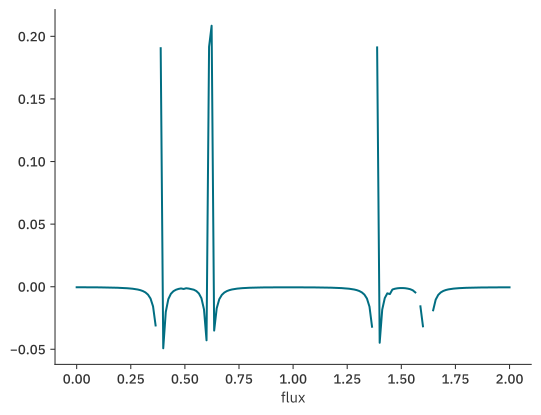
(Interruptions again mark dispersive-limit breakdown. The unattractive “spikes” actually correspond to capturing part of the transmon’s straddling regime, close to the breakdown of perturbation theory.)
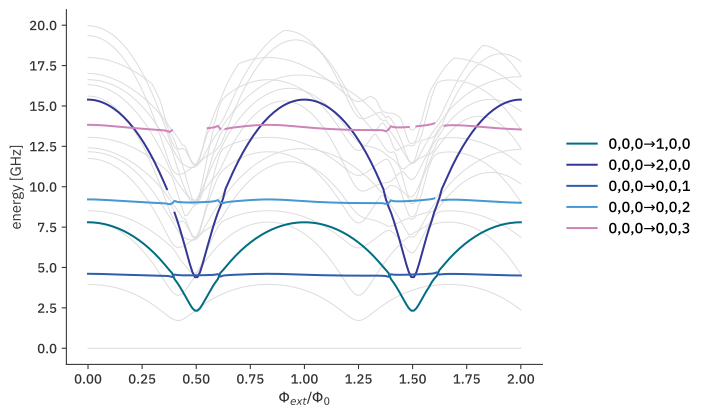
Inspection of the transition spectrum matches the positions of singular behavior in \(\chi\) with avoided crossings:
[4]:
sweep["ng":0].plot_transitions(subsystems=[tmon1, resonator]);
Note
Since dressed eigenenergies are used to compute these coefficients, results will not precisely agree with a purely perturbative calculations stopping at finite order. For instance, the coefficients calculated here will not always show the divergences typical for the breakdown of perturbation theory at avoided crossings.
Theoretical background, definition of dispersive quantities
Consider a system of harmonic modes (\(s=0,1,\ldots\)) and qubit modes (\(q=0,1,\ldots\)) coupled to each other,
Hamiltonian \begin{equation} H = \sum_s \omega_s a_s^\dagger a_s + \sum_{q,l} \epsilon^q_l |l_q\rangle\langle l_q| + \sum_{s\not=s'} g^{ss'}(a_s + a_s^\dagger)(a_{s'} + a_{s'}^\dagger) + \sum_{s,q,l} g^{sq}_{ll'} (a_s + a_s^\dagger)|l_q\rangle\langle l_q'| + \sum_{q\not=q'}\sum_{lm,l'm'}g^{qq'}_{lm,l'm'}|l_q l'_{q'}\rangle\langle m_q m'_{q'}| \end{equation}
If this system is fully dispersive, then the leading terms in the effective Hamiltonian, as obtained by a Schrieffer-Wolff transformation, can be written as:
Dispersive Hamiltonian \begin{align} H_\text{eff}&= E_0 + \underbrace{\sum_s (\omega_s + \Delta\omega_s) a_s^\dagger a_s + \sum_{q,l>0} (\bar{\epsilon}^q_l + \Delta \bar{\epsilon}^q_l)|l_q\rangle\langle l_q|}_\text{bare modes plus Lamb shifts} +\underbrace{\sum_{s;q,l>0}\bar{\chi}^{sq}_l a_s^\dagger a_s |l_q\rangle\langle l_q|}_\text{ac Stark shifts} +\underbrace{\sum_{s> s'} K_{ss'} a_s^\dagger a_s a_{s'}^\dagger a_{s'}}_\text{cross-Kerr}\\ &\quad +\underbrace{\sum_{s} K_{s} a_s^\dagger a_{s}^\dagger a_{s} a_{s}}_\text{self-Kerr} +\underbrace{\sum_{ql \not= q'l'} \Lambda^{qq'}_{ll'} |l_q,l'_{q'}\rangle \langle l_q, l'_{q'}|}_\text{interaction among anharmonic modes} \end{align}
Here, the energy coefficients are: \begin{align} &E_0 =\textstyle \sum_q \epsilon^q_0 && \text{(global energy offset)}\\ &\Delta\omega_s && \text{(harmonic mode frequency corrections)}\\ &\bar{\epsilon}^q_l = \epsilon^q_l - \epsilon^q && \text{(anharmonic mode energies relative to respective ground state energy)}\\ &\Delta\bar{\epsilon}^q_l && \text{(Lamb shifts)}\\ &\bar{\chi}^{sq}_l = \chi^{sq}_l - \chi^{sq}_0 && \text{(ac Stark shift for modes $s$ and $q$, relative to the $q=0$ state)}\\ &K_{ss'}, K_s && \text{(cross- and self-Kerr)}\\ &\Lambda^{qq'}_{ll'} && \text{("Kerr" among qubit modes)} \end{align}
Evaluation of energy coefficients
The various energy coefficients are evaluated by forming appropriate energy differences of the dressed eigenenergies. Denote the latter as
\begin{equation} E(n_1,n_2,\ldots;l_1,l_2,\ldots) = E(\vec{n},\vec{l})\end{equation}
With this the dispersive energy coefficients are:
Lamb shift, anharmonic mode \(\Delta\bar{\epsilon}^q_l = E(\vec{o},l\hat{e}_q) - E(\vec{o},\vec{o}) - \bar{\epsilon}^q_l\)
Lamb shift, harmonic mode \(\Delta\omega_s = E(\hat{e}_s,\vec{o}) - E(\vec{o},\vec{o}) - \omega_s\)
AC Stark shift \(\bar{\chi}^{sq}_l = E(\hat{e}_s,l\hat{e}_q) -(\epsilon^q_l + \Delta\epsilon^q_l) - (\omega_s + \Delta\omega_s) - E(\vec{o},\vec{o})\)
self-Kerr \(K_{s} = [E(2\hat{e}_s,\vec{o}) - E(\vec{o},\vec{o}) - 2(\omega_s + \Delta\omega_s)]/2\)
cross-Kerr \(K_{ss'} = E(\hat{e}_s + \hat{e}_{s'}) - E(\vec{o},\vec{o}) - (\omega_s + \Delta\omega_s) - (\omega_{s'} + \Delta\omega_{s'})\qquad (s\not=s')\)
anharmonic “Kerr” \(\Lambda^{qq'}_{ll'} = E(\vec{o}, l\hat{e}_q + l'\hat{e}_{q'},\vec{o}) - E(\vec{o},\vec{o}) - (\bar{\epsilon}^q_l + \Delta\bar{\epsilon}^q_l) - (\bar{\epsilon}^{q'}_{l'} + \Delta\bar{\epsilon}^{q'}_{l'})\qquad (s\not=s')\)